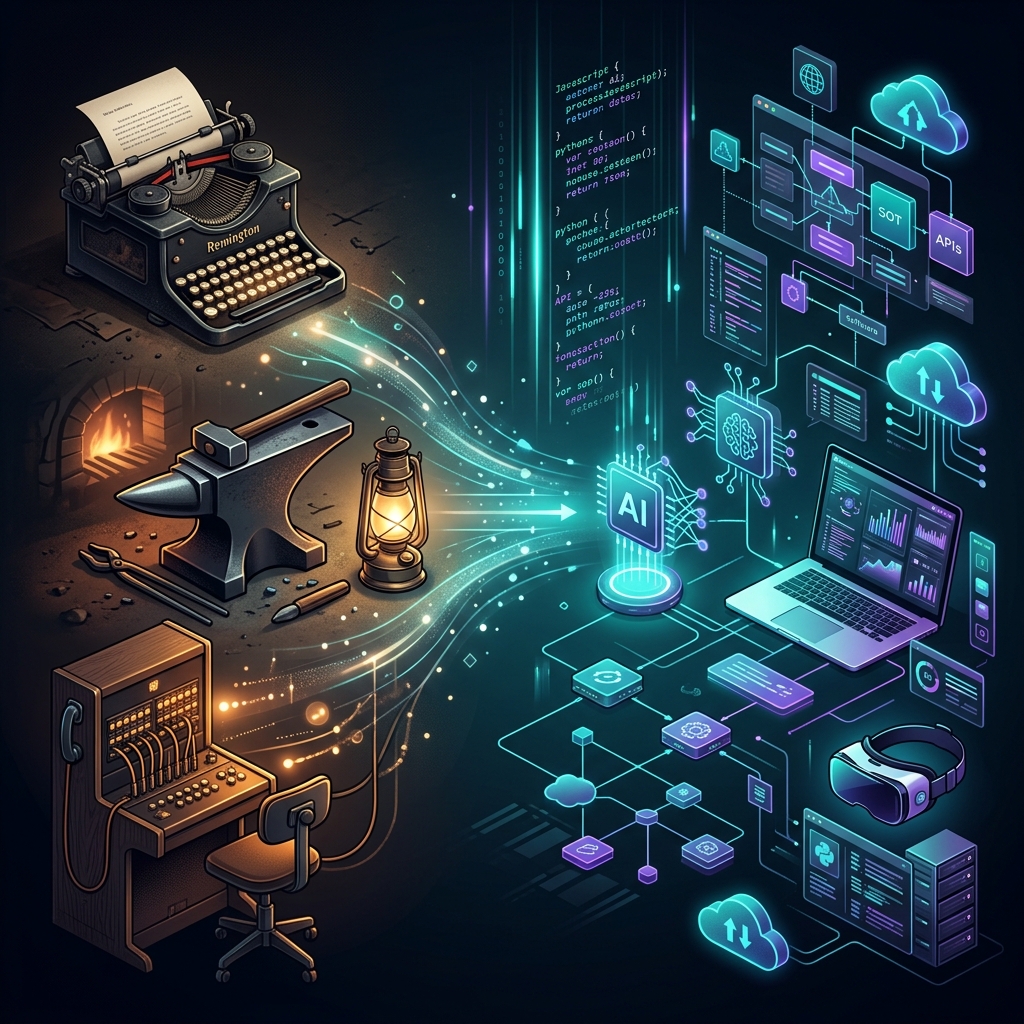
Every technological epoch is defined by the tools we build and the jobs we leave behind. When a system scales or a new abstraction layer is introduced, the legacy nodes of labor are inevitably deallocated.
Today, as we watch Large Language Models and autonomous agents begin to automate cognitive tasks, a familiar anxiety has returned to the developer community and the broader workforce. We worry about obsolescence, about our skills becoming dangling pointers.
But history is a reliable compiler. It shows us that while the syntax of work changes, the underlying execution engine remains the same: times change, and people adapt.
Consider the roles that once formed the backbone of our daily operations:
Phase 1: The Industrial Deallocations
- Blacksmiths and Nailers: Before the late 18th century, every nail holding together a house or a ship was forged by hand. “Nailers” spent fourteen hours a day hammering hot iron rods into shape. When mechanical nail-cutting machines emerged, they could produce thousands of nails in minutes. The hand-forged nail was permanently deprecated, but it allowed construction to scale at an unprecedented rate.
- Lamp Lighters: In the 19th century, cities relied on a fleet of workers to manually light, clean, and extinguish gas streetlamps every day. When electric street lighting and automated timer switches rolled out, the entire profession disappeared, giving rise to the modern nocturnal economy.
- Bowling Pin Setters: “Pin boys” sat at the end of bowling lanes, manually clearing fallen pins and resetting the rack. By the mid-20th century, mechanical pinsetters automated the entire loop, turning a dangerous, low-wage job into a reliable, automated sub-routine.
- Switchboard Operators: Early telephony required human operators to route calls by patching physical cords into socket panels. As call volumes scaled, the system became humanly unmanageable. Automatic electronic switching systems resolved the bottleneck, transitioning operators into customer service and systems administrators.
Phase 2: The Digital Migration
We do not have to look back centuries to see this pattern. The transition has continued right into our recent past, shifting from physical automation to digital abstraction:
- Draftsmen: Before the 1980s, engineering and architectural firms employed rows of draftsmen who hand-drew schematics on massive drafting tables using T-squares and pencils. Computer-Aided Design (CAD) software digitized the paper, turning manual perspective and scaling into software-rooted constraints.
- Travel Agents: Booking a flight or hotel once required a trip to a local agency where an agent query-searched flights on dedicated terminals. The rise of self-service web APIs (Expedia, Skyscanner) abstracted the middleman booking procedures directly to consumer-facing web applications.
- Video Store Clerks: Managing physical cassette tape and DVD inventories, processing late fees, and acting as local movie recommendation engines were standard retail staples. High-bandwidth streaming infrastructure and algorithmic recommendation engines turned these physical outposts into digital streams.
- Floor Traders: Stock exchanges once hummed with shouting floor traders flashing hand signals to match buy and sell transactions. Electronic matching engines and retail investment APIs abstracted the chaotic trading pit into sub-millisecond database updates.
The Luddite Response
When the automated shearing frames and power looms were introduced in 19th-century England, the hand-loom weavers realized their specialized skills were being bypassed. They organized under the mythical name of General Ned Ludd, breaking into factories to smash the machines that threatened their livelihood.
The Luddites are often caricatured today as simple anti-technology reactionaries. In reality, their struggle was not with the machines themselves, but with the rapid degradation of their labor value and the loss of their independence. They were protesting a system design that used automation to centralize wealth while deallocating the worker.
Their rebellion failed to halt the machines, but it serves as a permanent warning: the friction of technological transition is not a technical problem—it is a social and economic integration test.
The Law of Upward Abstraction
When a task is automated, it does not disappear; it is pushed down into the platform layer.
- The blacksmith’s anvil became the automated foundry, which became the CAD-designed structural steel of our skyscrapers.
- The telephone switchboard became the digital routing tables of the global internet, which became the virtual private clouds (VPCs) we configure today.
- The travel agent’s booking terminal became the public travel booking API, which is now being integrated into autonomous agent pipelines.
- The video store shelf became the cloud-based streaming container, governed by high-concurrency content delivery networks (CDNs).
As developers and architects, we are not defined by the specific syntax we write or the specific tools we configure. If our job were merely typing characters into a terminal, we would have been obsolete long ago. Our value lies in system design, threat modeling, state management, and the translation of complex human requirements into reliable execution paths.
AI is the next major compiler. It will automate the low-level syntax of coding, writing, and administrative routing. It will force us to move up the stack, to design at a higher level of abstraction, and to manage networks of autonomous agents rather than writing line-by-line implementations.
The transition will be loud, and the friction will be real. But the pattern is ancient. The old nodes will be deallocated, the system will rebalance, and we will build on top of the new foundation.
Forge the next layer.