There’s a difference between a stock going up because of hype and a stock going up because the world finally understood what it was looking at.
Today was the second kind.
AMD closed up 19%. Hut 8 closed up 28%. On the same day. For two companies in completely different industries.
That’s not a coincidence. That’s a thesis being confirmed in real-time.
AMD: The Market Stopped Underwriting the “Nvidia-Only” Narrative
For eighteen months, Wall Street had one frame for AI chips: Nvidia or nothing. The H100 was the only GPU that mattered. The waiting list was eighteen months long. And AMD was, charitably, described as “a worthy challenger” — the kind of phrasing that means “don’t bother.”
Then Q1 2026 landed.
$10.25 billion in revenue. Not a beat — a beat with a statement. The data center segment was up 57% year-over-year, driven by accelerating MI300X deployments across hyperscalers that simply couldn’t wait any longer for Nvidia’s allocations. CEO Lisa Su raised Q2 guidance to $11.2 billion, more than $700 million above consensus.
Goldman Sachs raised their target. Barclays raised their target. Bank of America raised their target.
Here’s what the market actually repriced: it was never a question of whether AMD’s chips were good enough. It was a question of whether demand was large enough to support a second major player at scale. Today’s numbers answered that question definitively.
The demand for AI compute is not a niche market. It is not a bubble. It is a once-in-a-generation infrastructure buildout, and it is large enough to produce multiple $10B-plus revenue winners simultaneously.
Hut 8: The Landlord of the AI Era
The more structurally interesting story — and the one that will matter most five years from now — is Hut 8.
Hut 8 started as a Bitcoin miner. That description is now almost entirely misleading.
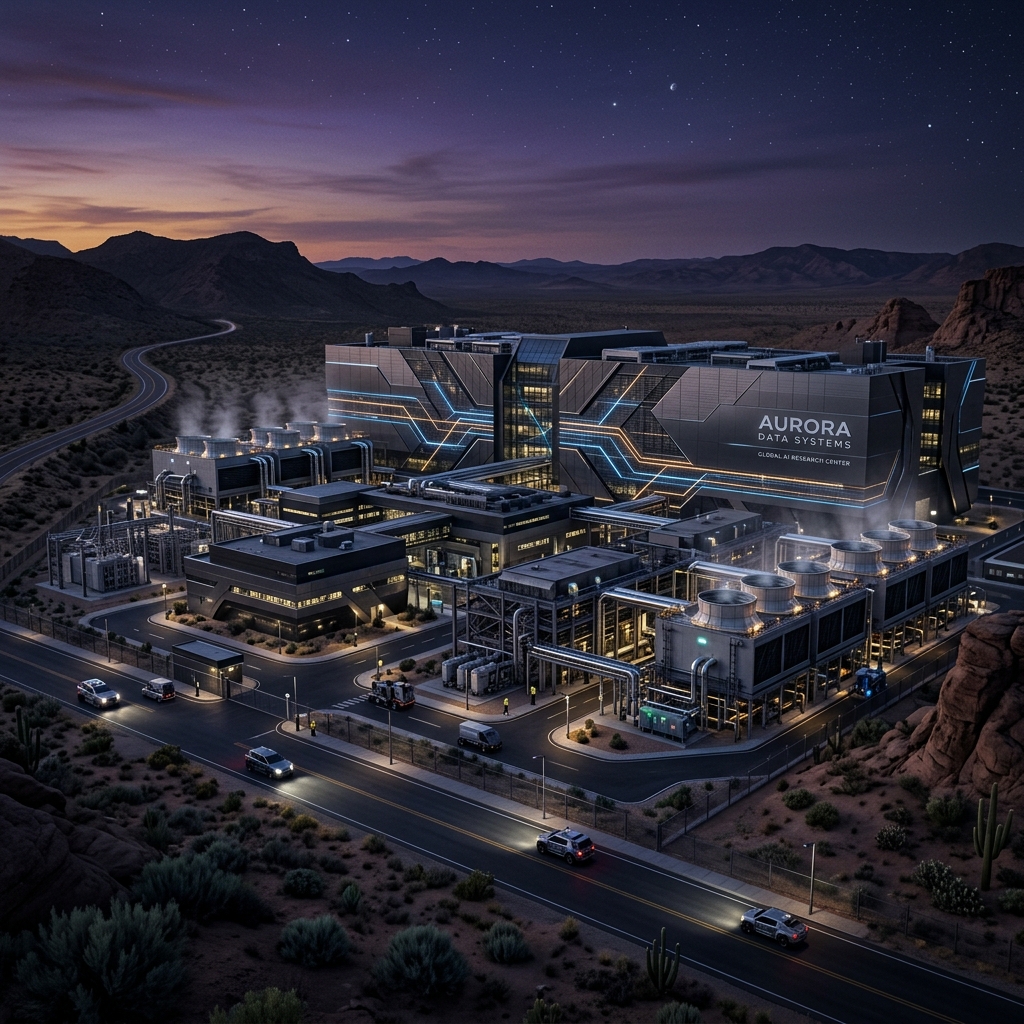
Today, they announced a 15-year lease agreement worth $9.8 billion for 352 megawatts of IT capacity at their Beacon Point campus in Texas. The tenant is not named, but the profile of the deal is clear: an investment-grade technology company locked in for a decade and a half because they needed guaranteed, large-scale compute capacity and they couldn’t build it fast enough themselves.
Think about what Hut 8 actually is, stripped of the crypto framing: a company that knows how to acquire power at scale, build hardened physical infrastructure, and cool hundreds of megawatts of dense compute loads — at cost.
That skill set, which looked like a Bitcoin trade three years ago, is now one of the scarcest capabilities on earth.
By signing this lease, Hut 8 has effectively converted a volatile, mark-to-market crypto asset into a 15-year annuity backed by AI infrastructure demand. Their balance sheet risk profile just changed fundamentally. The market moved 28% because it recognized the restructured cash flow, not because of the Q1 earnings (which, at $71 million in revenue against a $9.8B lease announcement, barely mattered).
The Pattern Under Both Stories
Strip away the ticker symbols, and you see the same thing in both AMD and Hut 8:
The physical layer of the AI revolution is now the most constrained — and therefore most valuable — asset in the technology ecosystem.
You can train a better model. You can write a better algorithm. You can iterate on your product in days. But you cannot conjure 352 megawatts of power-secured data center capacity in Texas. You cannot fabricate an MI300X or an H100 faster than the semiconductor supply chain allows.
The software layer of AI has near-zero marginal cost. A better model can be deployed globally the day it’s ready. But the infrastructure layer — the silicon, the power, the cooling, the physical buildings — has extremely high marginal cost, long lead times, and massive capital requirements.
Markets price scarcity. And right now, the most scarce assets in the AI stack are the ones you can’t download.
What This Means Going Forward
The first chapter of the AI boom was won by model builders: OpenAI, Anthropic, Google DeepMind. Their names were on the front page.
The second chapter is being won by infrastructure providers. Their names are on the lease agreements.
This is not a new pattern. The California Gold Rush of 1849 made a handful of miners rich. The people who got reliably wealthy were the ones who sold the picks, the shovels, and the denim. Levi Strauss didn’t mine for gold. He outfitted the people who did.
AMD makes the picks. Hut 8 rents the mine.
The Bottom Line
A 19% move in a $180 billion company is not retail sentiment. It is institutional repricing. It means the people managing pension funds and sovereign wealth portfolios have updated their models and are buying.
A 28% move in a company that just signed a $9.8 billion lease means the market looked at 15 years of contracted AI infrastructure revenue and decided the old valuation was wrong.
Taken together, today’s market is making one argument, loudly:
The AI Revolution is not a software story. It is an infrastructure story. And the infrastructure is not built yet.
The question isn’t whether you believe in AI. The question is whether you understand what has to be physically constructed for it to run.
References & Further Reading
- AMD Q1 2026 Earnings — Investor Relations — Official revenue figures and segment breakdowns.
- Hut 8 Beacon Point Lease Announcement — The $9.8B, 15-year AI data center deal in full.
- The Economics of AI — NBER analysis of AI’s physical constraints and capital intensity.
- The Second Machine Age — Brynjolfsson & McAfee on the economics of the digital-physical divide.
- The Wealth of Nations — Adam Smith on scarcity, specialization, and why infrastructure always precedes growth.